
Food inventory generates disposal problems that other categories do not. It spoils on a schedule, it arrives packaged in materials that need separating, it is subject to recall and food safety rules, and in a growing number of jurisdictions it cannot legally be sent to landfill in commercial volumes at all.
Manufacturers, distributors, grocery operators, food service businesses, and co-packers all face the same question when product cannot be sold: how does it leave the building in a way that is compliant, cost-controlled, and documented. This guide walks through the answer.
Organic Waste Rules Are Tightening
A growing number of states and municipalities now restrict commercial organic waste from landfill, typically applying the requirement above a defined volume threshold and requiring diversion to composting, anaerobic digestion, or animal feed where suitable. Thresholds and covered business types differ meaningfully by jurisdiction, so the applicable rule for a multi-site operator is often not the same at every location.
The practical effect is that food waste disposal has shifted from a hauling decision to a compliance decision, and businesses that have not reviewed their arrangements recently may be operating under rules that changed since the contract was signed.
Not All Food Waste Takes the Same Route
Edible Surplus
Product that is still safe and within date may be donatable, and federal liability protections exist for good-faith food donation. This is the highest-value outcome where it genuinely applies, but it applies to fewer loads than businesses assume.
Expired and Spoiled Product
Not fit for consumption and not donatable, but frequently suitable for composting or anaerobic digestion once separated from packaging.
Recalled and Contaminated Product
Requires a documented route that keeps it permanently out of the food supply, with lot-level accounting matched against the recall notice. This is the category where a general hauler is least appropriate.
Mislabeled or Undeclared Allergen Product
Physically edible but legally unsellable and unsafe for a subset of consumers, so it cannot be donated or diverted to any human food channel.
Packaged Liquids and Beverages
Need depackaging rather than direct discharge, since sugar and solids loading places significant demand on treatment systems and many jurisdictions restrict it.
How Depackaging Works
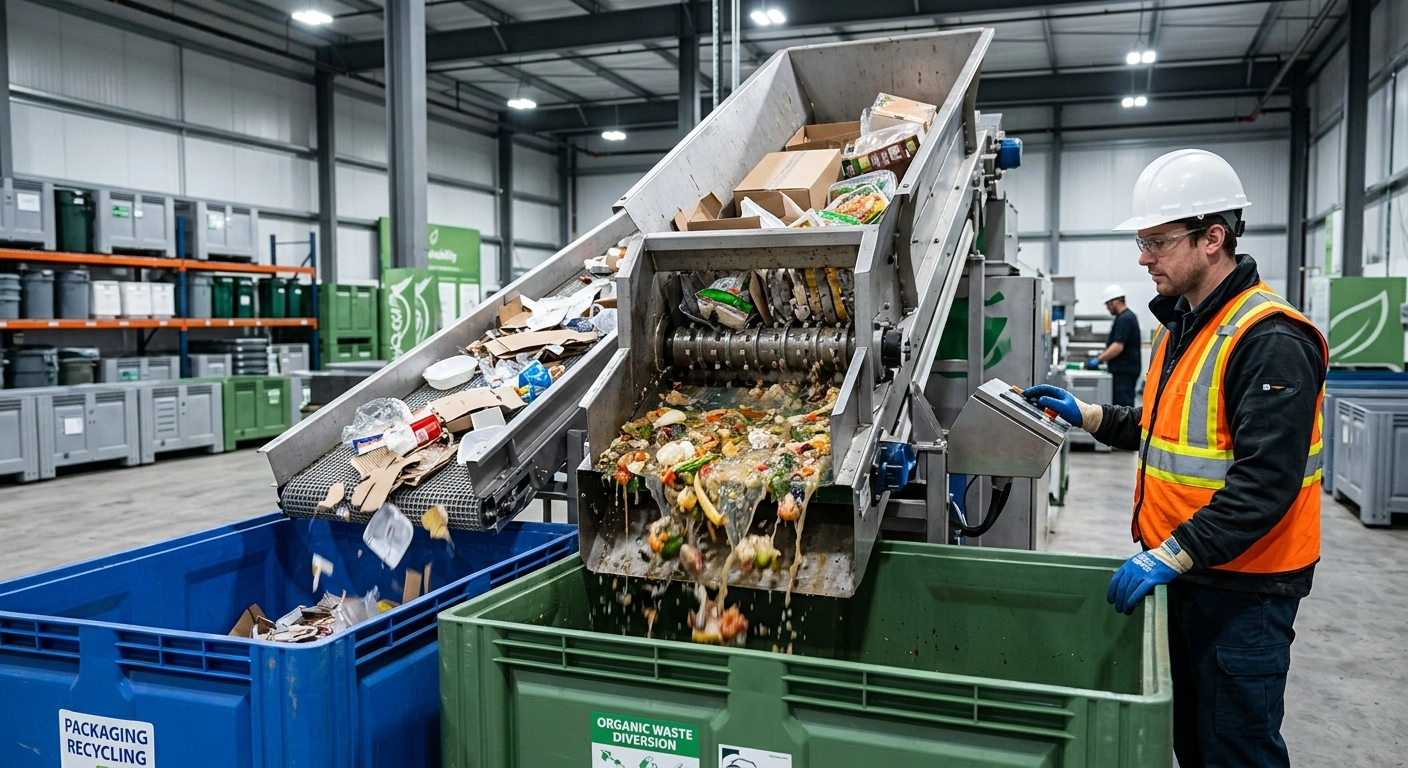
Most commercial food waste arrives sealed in packaging, which blocks both composting and digestion. Industrial depackaging equipment separates the organic fraction from cartons, film, glass, cans, and plastics, producing a clean organic stream that a composter or digester will accept and a packaging stream that can go to recycling.
This is what allows a business to achieve a high diversion rate on packaged product without any manual unwrapping, and it is the step most general waste contracts do not include.
What a Compliant Food Disposal Project Produces
- Scheduled or on-demand collection sized to your volume, with temperature-appropriate handling where required
- Segregation of organic material, packaging, and any non-conforming waste
- Depackaging where product is sealed or containerized
- Diversion to composting, anaerobic digestion, or energy recovery where the material and regulations permit
- Lot-level tracking tied to recall codes where relevant
- Weight and volume data suitable for waste and sustainability reporting
- A Certificate of Disposal recording what was processed, when, where, and by which method
Recalled Food Needs More Than a Hauler
When disposal is driven by a recall, regulators expect the business to account for the specific units covered, not a general quantity. Lot numbers, date codes, and quantities need to be recorded and reconciled against the recall notice, and the resulting certificate should reference those specifics directly. A weight ticket from a landfill does not satisfy this, and reconstructing the detail afterward is rarely possible.
Get Food Waste Disposal Handled Compliantly
At inventorydisposal.com, we handle food and organic waste disposal for businesses with depackaging, diversion to composting and digestion where the material allows, and a Certificate of Disposal issued on every project. Contact our team today for a fast quote and compliant food waste disposal across all 50 states.