
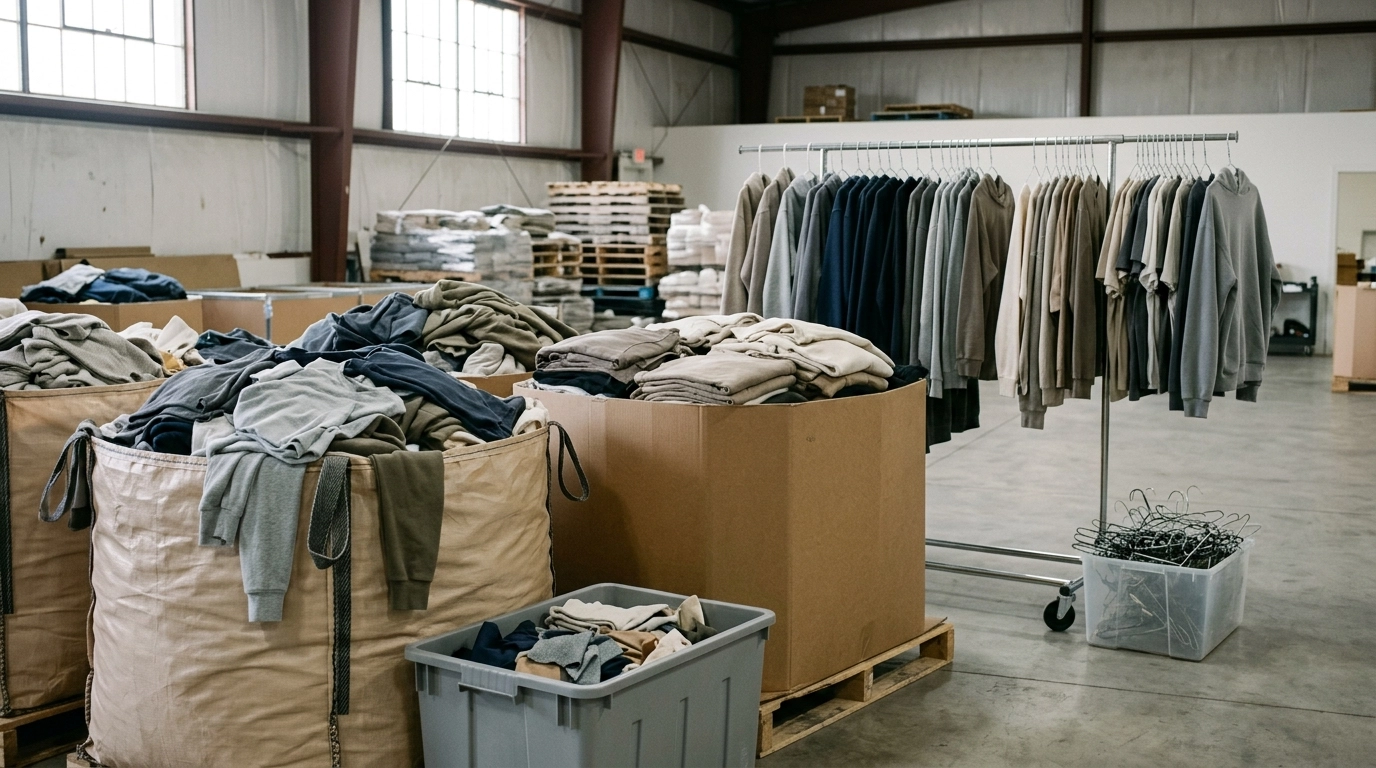
Every apparel business accumulates stock it cannot sell. Broken size runs, off-season carryover, defective production, returned garments in unknown condition, and samples that were never meant for retail. The volumes are large, the value is close to zero, and the storage cost is not.
Donation is the answer most companies reach for first, and for a portion of this inventory it is genuinely the right one. For the rest it is not, and understanding the difference prevents a well-intentioned decision from turning into a problem.
Where Donation Works and Where It Does Not
Donation makes sense for current, undamaged, correctly labeled garments that carry no safety concern and no contractual restriction. That describes a real share of unsold apparel, and destroying it would be waste for its own sake.
It stops making sense quickly beyond that. Charities have limited capacity to absorb bulk volume, and material they cannot place moves into secondary channels, frequently for export, where a large proportion eventually becomes waste in a country with less infrastructure to handle it. Donating a container of unsellable stock can simply relocate the disposal problem while allowing everyone to feel it was solved.
What Should Not Be Donated
- Garments recalled or withdrawn for a safety reason, including drawstring, flammability, or small parts issues on children’s apparel
- Defective production that failed quality inspection
- Water-damaged, mold-affected, or contaminated stock
- Licensed and co-branded product where the agreement has ended
- Counterfeit or unauthorized production identified through enforcement
- Uniforms, workwear, and staff-issued garments carrying logos or identification
- Items where the brand risk of the garment circulating outweighs the benefit
The uniform point is worth emphasizing because it is consistently underestimated. A branded uniform is a credible way for someone to appear to be your employee, which makes it a security item rather than a clothing item.
How Textile Disposal Actually Works
Sorting and Grading
Incoming material is separated by fiber type, condition, and construction. This step determines everything downstream, because the available routes for a cotton tee shirt and a coated polyester jacket are completely different.
Fiber Recovery and Downcycling
Material that cannot be reused as clothing can often be recovered as fiber. Common destinations include industrial wiping cloths, shoddy fiber for insulation and padding, carpet underlay, and automotive sound deadening. This is downcycling rather than recycling in the strict sense, but it keeps meaningful tonnage out of landfill.
Energy Recovery and Landfill as Last Resort
Material too contaminated or too mixed to recover goes to waste-to-energy where that infrastructure is available, and to landfill only where nothing else applies. A disposal partner should be able to tell you what proportion went where.
Trims and Blends Are What Limit Recyclability
The barrier to textile recovery is rarely the fabric. It is everything attached to it. Zippers, rivets, buttons, elastic, foam padding, waterproof coatings, and heat-applied prints all have to be dealt with, and blended fabrics cannot be separated back into their component fibers at commercial scale.
This is why quotes vary so much between apparel loads that look similar. A pallet of plain cotton tees and a pallet of technical outerwear are not the same job.
Do Not Forget the Packaging
Polybags, hangtags, hangers, cartons, and branded tissue arrive with the garments and account for real volume. Hangers in particular are frequently recoverable through dedicated programs. Branded hangtags and packaging should be destroyed rather than passed on intact.
Diversion Reporting
If your business reports on landfill diversion or sustainability targets, the disposal record needs to support the claim. That means weights recorded by outbound stream rather than one total figure, so you can state a defensible diversion percentage rather than an estimate.
Clear Apparel Inventory Responsibly
At inventorydisposal.com, apparel and textile projects are handled with sorting by fiber and condition, recovery routed wherever the material allows, separate handling of trims and packaging, weights recorded by stream, and a Certificate of Disposal issued on every project.
Contact our team today for a fast quote and compliant apparel disposal across all 50 states.
