
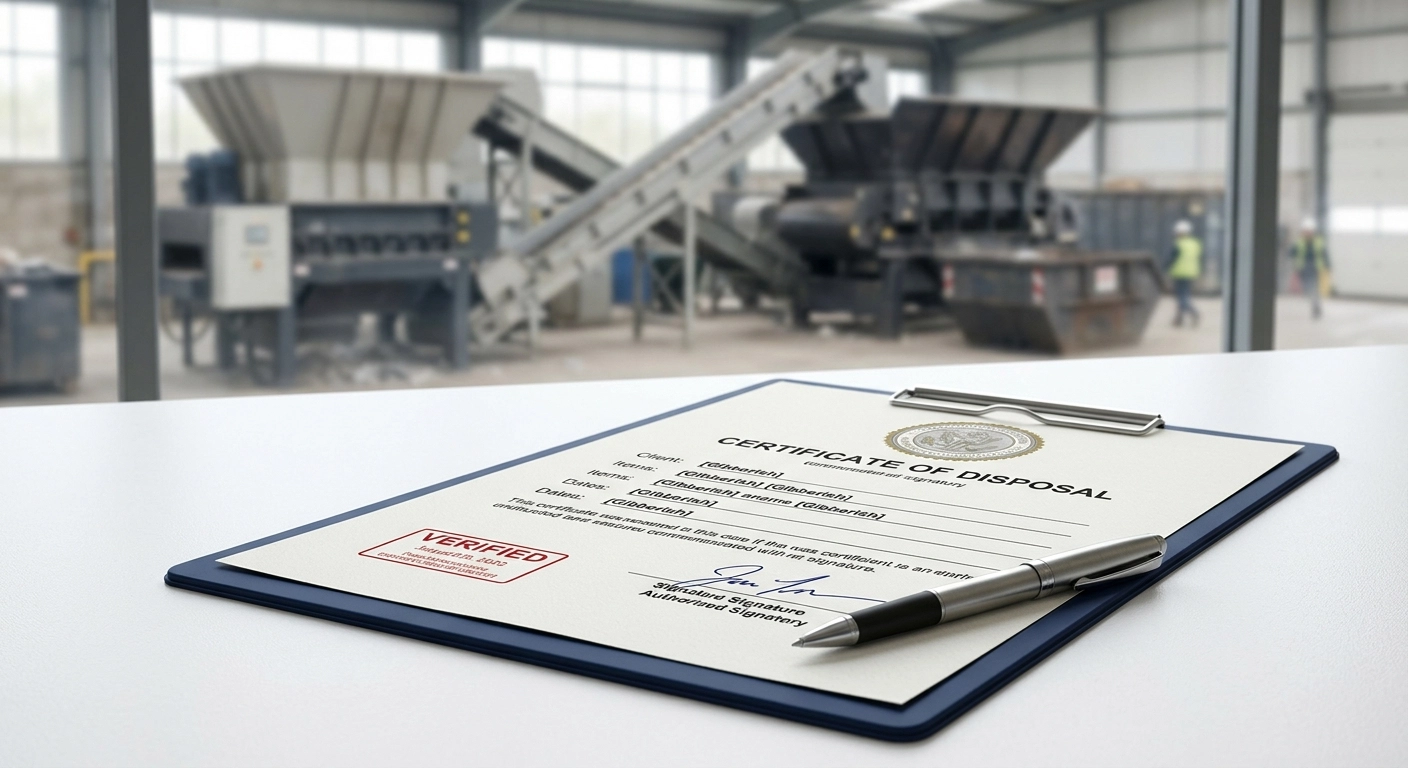
Disposing of unsellable inventory is only half the job. The other half is being able to prove it happened, in the right way, at the right time, and to the right standard. That proof takes the form of a Certificate of Disposal, and for most regulated categories it is the single most valuable document you walk away with when a project closes.
This guide explains what a Certificate of Disposal is, what a good one contains, who is likely to ask you for it, and why it belongs on every project rather than only the large ones.
What a Certificate of Disposal Actually Is
A Certificate of Disposal is a formal document issued by the disposal provider confirming that specific inventory was processed through compliant channels on a specific date. It records what left your facility, where it went, how it was handled, and who was responsible. In practical terms it functions as a receipt for disposal, one that can be produced on demand months or years after the truck pulled away.
Without it, your record of the event is entirely internal. You have a journal entry and possibly a delivery note, but nothing from an independent party confirming that the goods actually reached a compliant endpoint rather than being resold, diverted, or dumped.
What a Strong Certificate Contains
Certificates vary enormously in quality. A one-line document stating that materials were disposed of provides very little protection. A properly prepared certificate includes specifics that can be checked:
- Your business name and the originating facility or location
- An itemized list of what was disposed of, by SKU, description, lot number, and quantity or weight
- The disposal method used, whether recycling, waste-to-energy, licensed landfill, depackaging, or destruction
- The date the disposal took place and the facility where it occurred
- The name, address, and applicable permits or certifications of the processing facility
- An authorized signature confirming the project was completed as described
Itemization is what gives the document evidentiary weight. In a recall or a write-off review, the question is rarely whether you disposed of something. It is whether you disposed of the specific lots in question, and only a certificate with lot-level detail answers that.
Who Asks For It
Regulators
The FDA, EPA, DEA, USDA, and state environmental and health agencies all expect documented evidence of proper disposal for regulated categories, and recall closeout procedures typically require it directly.
Auditors and Finance Teams
Inventory write-offs reduce taxable income, which makes them a natural area of scrutiny. Third-party disposal documentation is stronger evidence than internal records because it was produced by a party with no stake in the accounting treatment.
Insurance Providers
Claims for damaged, spoiled, or contaminated stock generally require confirmation that the goods were not later salvaged or resold.
Customers and Retail Partners
Large retailers increasingly ask suppliers to evidence how withdrawn or discontinued product was handled, particularly where their own brand appears on the packaging.
Sustainability and ESG Reporting
Where a certificate records diversion outcomes such as recycling or energy recovery, it becomes source data for waste reporting rather than an estimate.
Certificate of Disposal or Certificate of Destruction?
Both terms appear in the industry and they are not identical. A Certificate of Disposal confirms that inventory was routed through compliant, licensed channels, which may include recycling, energy recovery, or permitted landfill. A Certificate of Destruction confirms something narrower and stronger: that the items were rendered permanently unrecoverable, typically by shredding or incineration.
Which one you need depends on the risk you are managing. For general excess stock, packaging waste, and non-branded material, a Certificate of Disposal is the appropriate record. For branded goods, recalled product, controlled substances, or anything where resale or diversion would create liability, ask for destruction and a certificate that says so explicitly.
Request It on Every Project, Not Just the Big Ones
The most common mistake is treating documentation as something to arrange when an audit is expected. Requirements surface unpredictably, often long after the disposal, and a certificate cannot be created retroactively for an event that was never documented. A single pallet cleared today can become relevant to a claim, an audit, or a customer inquiry two years from now.
Get a Certificate of Disposal on Every Project
At inventorydisposal.com, we issue an itemized Certificate of Disposal as a standard deliverable on every project, regardless of size or product category, alongside full documentation of how your inventory was handled. Contact our team today for a fast quote and compliant disposal across all 50 states.